BulbiCARE®
Advanced Screening Through Eye Movement with MDR Class IIa Validation
BulbiCARE® uses eye tracking to screen for multiple conditions by measuring eye movements against validated biomarkers, providing objective data that can supplement clinical assessment.
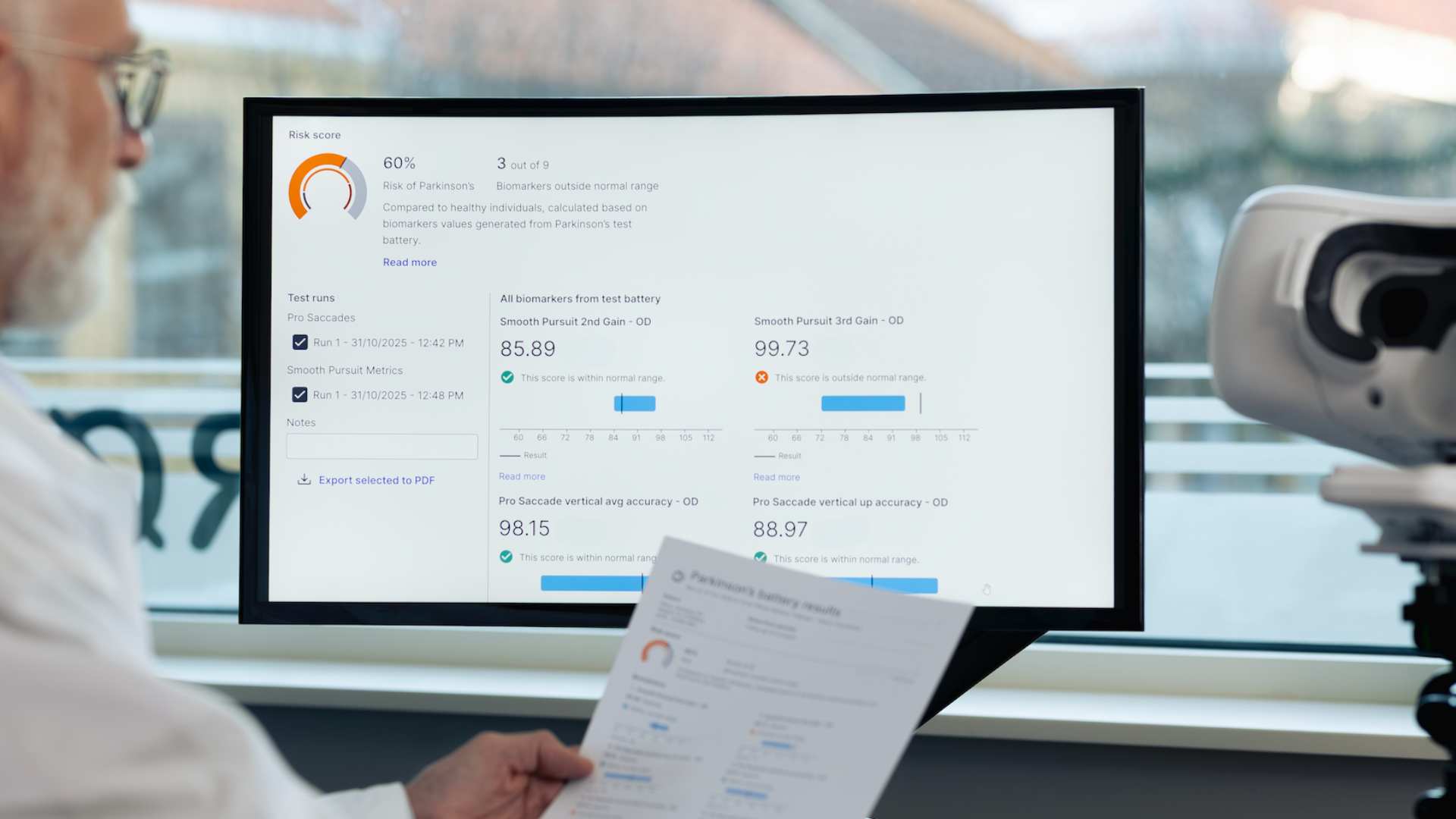
Image shown is for illustrative purposes only. The final product may differ in appearance.
Validated Clinical Tests
11 Tests for Neurological and Ophthalmological Evaluation
-
The Pupil Dynamics test is a non-invasive, quantitative assessment tool designed to measure various aspects of pupillary function in patients. This test utilizes specialized imaging technology to evaluate pupillary responses to controlled light stimuli.
Specific Purposes:
To objectively measure and quantify pupil diameters
To determine pupil peak velocity during constriction and dilation
To detect asymmetries or abnormalities in pupillary responses
-
The RAPD test is a non-invasive, quantitative assessment tool designed to detect differences in pupillary light responses between the two eyes. This test utilizes controlled light stimuli and precise pupillary measurement technology to evaluate asymmetries in the afferent pupillary pathway.
Specific Purposes:
To objectively detect and quantify relative afferent pupil defects
To aid in the detection of unilateral or asymmetrical signal transmission losses in the visual pathway
To provide clinicians with functional, quantified pupil measurement that can be integrated into their clinical decision-making process in conditions affecting the retina, optic nerve, or visual pathway
-
The Smooth Pursuit test is a non-invasive, quantitative assessment tool designed to evaluate the eyes' ability to accurately track a moving visual target. This test utilizes high-precision eye tracking technology to measure various aspects of smooth pursuit eye movements.
Specific Purposes:
To evaluate the gain of smooth pursuit eye movements
To provide neurologists or other specialists with demonstrated expertise in the diagnosis and management of neurological or neuro-ophthalmological diseases with functional, quantified ocular measurements that can be integrated into their clinical decision-making process in conditions affecting ocular motor control
-
The Horizontal Pro-Saccade test is a non-invasive, quantitative assessment tool designed to evaluate rapid, reflexive eye movements (saccades) in response to visual stimuli. This test utilizes high-precision eye tracking technology to measure various aspects of pro-saccadic eye movements.
Specific Purposes:
To objectively measure and quantify pro-saccade characteristics
To assess the accuracy of saccadic eye movements
To measure the peak velocity of saccades
To provide neurologists or other specialists with demonstrated expertise in the diagnosis and management of neurological or neuro-ophthalmological diseases with functional, quantified ocular measurements that can be integrated into their clinical decision-making process in conditions affecting ocular motor control
-
The Multidirectional Pro-Saccade test is a non-invasive, quantitative assessment tool designed to evaluate rapid, reflexive eye movements (saccades) in response to visual stimuli. This test utilizes high-precision eye tracking technology to measure various aspects of vertical and horizontal pro-saccadic eye movements.
Specific Purposes:
To objectively measure and quantify pro-saccade characteristics
To assess the accuracy of saccadic eye movements
To measure the peak velocity of saccades
To provide neurologists or other specialists with demonstrated expertise in the diagnosis and management of neurological or neuro-ophthalmological diseases with functional, quantified ocular measurements that can be integrated into their clinical decision-making process in conditions affecting ocular motor control
-
The Visual Field Perimetry test, also known as Eye Movement Perimetry, is a non-invasive, quantitative assessment tool designed to evaluate peripheral vision and eye movement responses in patients. The test evaluates 60 peripheral points. This application is to provide clinicians with functional, quantified ocular measurements that can be integrated into their clinical decision-making process in conditions of ocular and neurological diseases affecting the visual field.
Specific Purposes:
To objectively measure and quantify sensitivity in the peripheral visual field
To detect and quantify field loss in the subject's peripheral visual field by identifying seen/unseen targets
To measure the subject's saccadic reaction time (latency) to peripheral visual stimuli
To aid in the diagnosis to provide clinicians with functional, quantified ocular measurements that can be integrated into their clinical decision-making process of pathologies or other conditions affecting peripheral vision
-
The Pursuit Acuity test is a non-invasive, quantitative assessment tool designed to measure central visual acuity in patients. This test utilizes eye movement tracking technology to evaluate a subject's ability to follow high-contrast moving stimuli of decreasing size.
Specific Purposes:To objectively measure and quantify central visual acuity
To detect potential vision loss in the subject's central vision
To provide clinicians with functional, quantified ocular measurements that can be integrated into their clinical decision-making process
-
The Pursuit Contrast Sensitivity test is a non-invasive, quantitative assessment tool designed to measure contrast sensitivity in patients. This test utilizes eye movement tracking technology to evaluate a subject's ability to detect and follow moving stimuli of varying contrast levels.
Specific Purposes:
To objectively measure and quantify contrast sensitivity
To detect potential impairments in contrast perception
To provide clinicians with functional, quantified ocular measurements that can be integrated into their clinical decision-making process
-
The Strobe Contrast Sensitivity test is a non-invasive, quantitative assessment tool designed to measure the latency in adapting to various light conditions in foveal photoresistors and their accompanying retinal neurons in patients. This test utilizes eye movement tracking technology in combination with controlled light stimuli to evaluate a subject's ability to maintain visual tracking under varying light conditions. This test determines the threshold frequency where a fixed-contrast stimulus becomes undetectable.
Specific Purposes:
To objectively measure and quantify foveal light adaptation latency
To detect potential impairments in foveal light adaptation latency
To provide clinicians with functional, quantified ocular measurements that can be integrated into their clinical decision-making process in conditions affecting the retina, optic nerve, or visual pathway
-
The Variable Strobe test is a non-invasive, quantitative assessment tool designed to measure the latency in adapting to various light conditions in foveal photoreceptors and their accompanying retinal neurons in patients. This test utilizes eye movement tracking technology in combination with controlled light stimuli to evaluate a subject's ability to maintain visual tracking under varying light conditions.
Specific Purposes:
To objectively measure and quantify foveal light adaptation latency
To detect potential impairments in foveal light adaptation latency
To provide clinicians with functional, quantified ocular measurements that can be integrated into their clinical decision-making process in conditions affecting the retina, optic nerve, or visual pathway
-
The Ptosis test (MRD1 and MRD2) measurements are intended to be used by healthcare professionals as an objective, quantitative assessment of eyelid position and function. These measurements should be interpreted in the context of the patient's full clinical presentation, medical history, and other relevant diagnostic findings.
Streamlined workflow
-
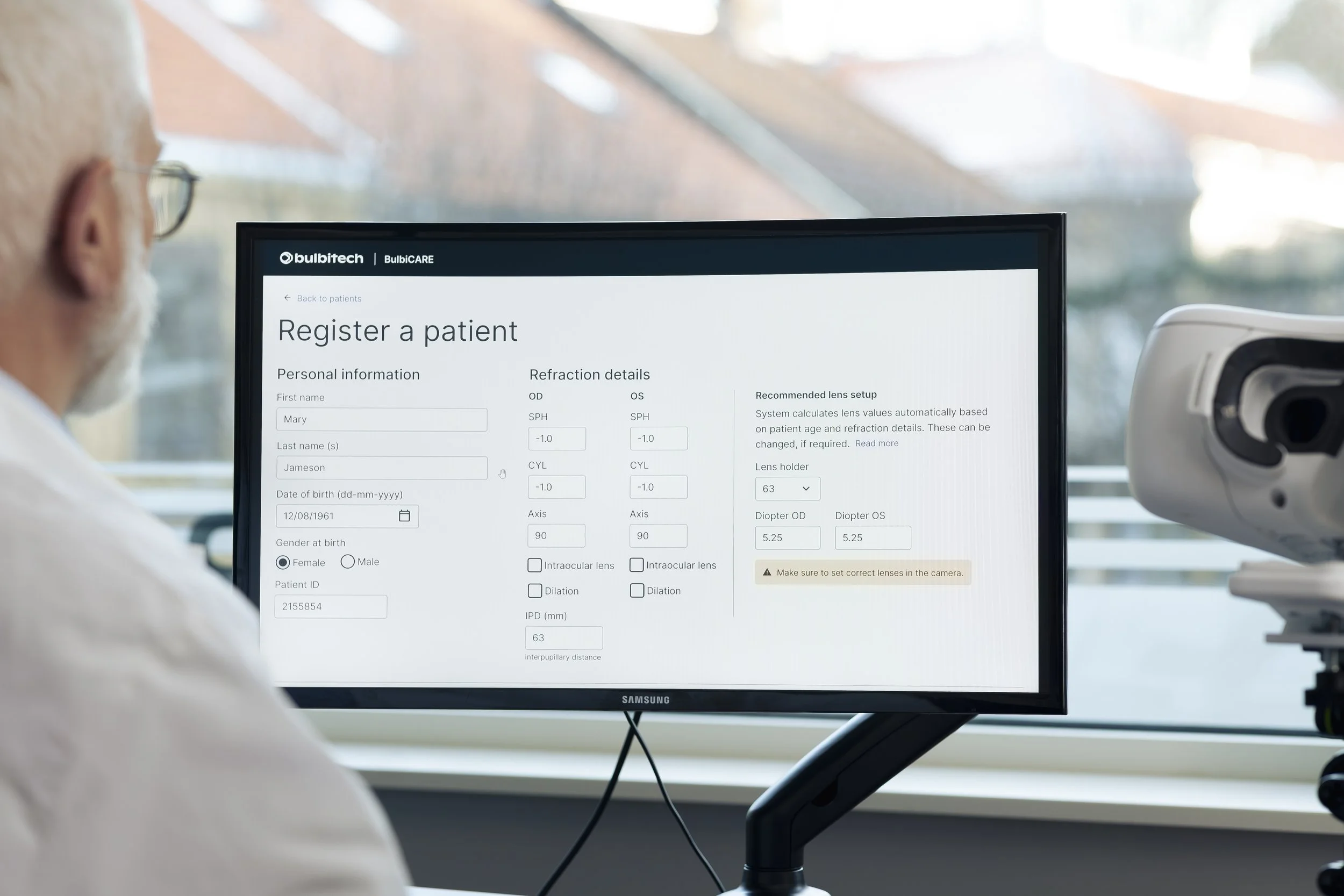
![A medical professional looking at a computer monitor displaying a patient registration form with personal and refraction details in a clinical setting with medical equipment nearby.]()
1. Launch BulbiCARE® and add patient details
-
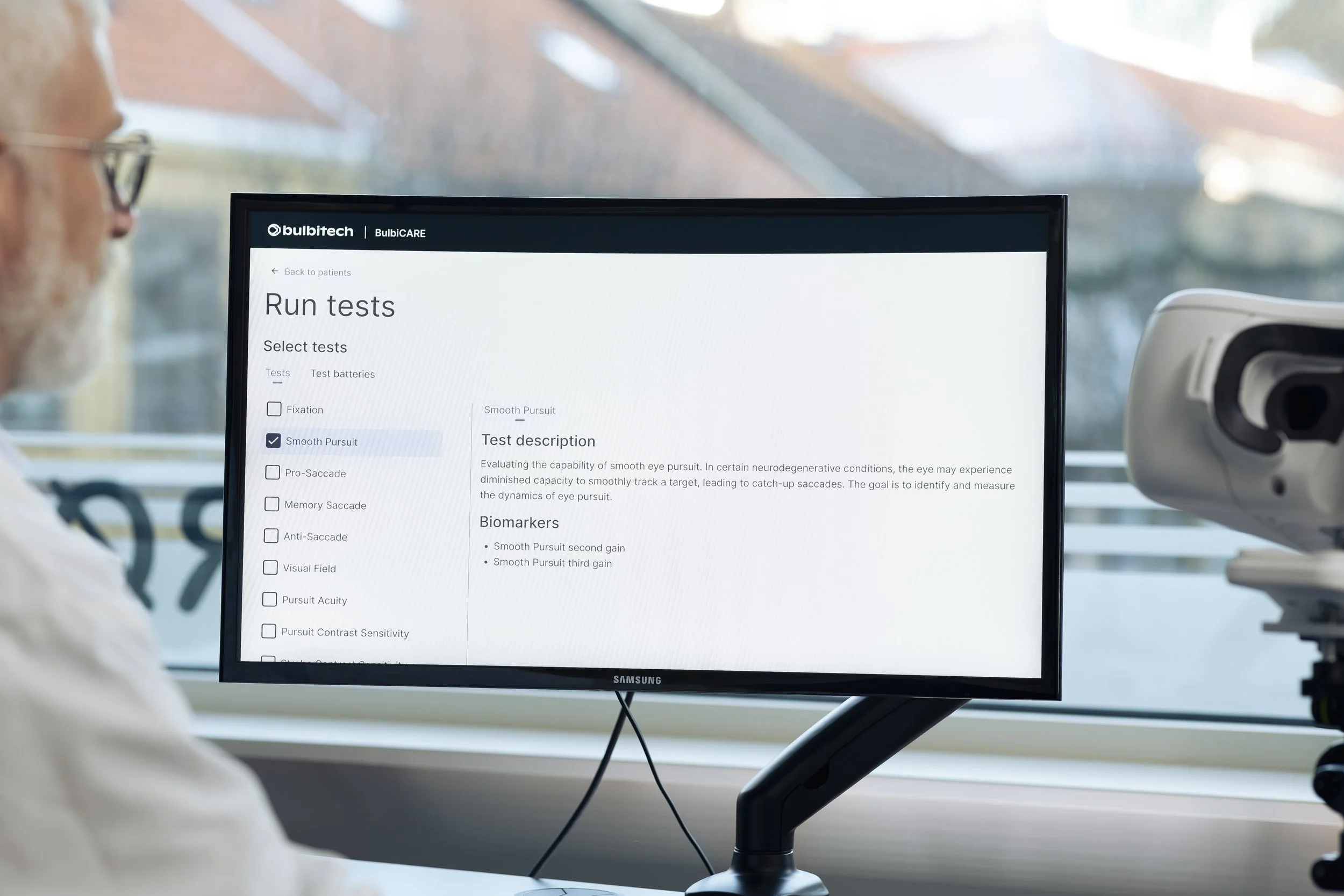
![A doctor reviews a computer screen with medical test options, including 'Smooth Pursuit', in a clinical setting near a window with a microscope nearby.]()
2. Select tests
-
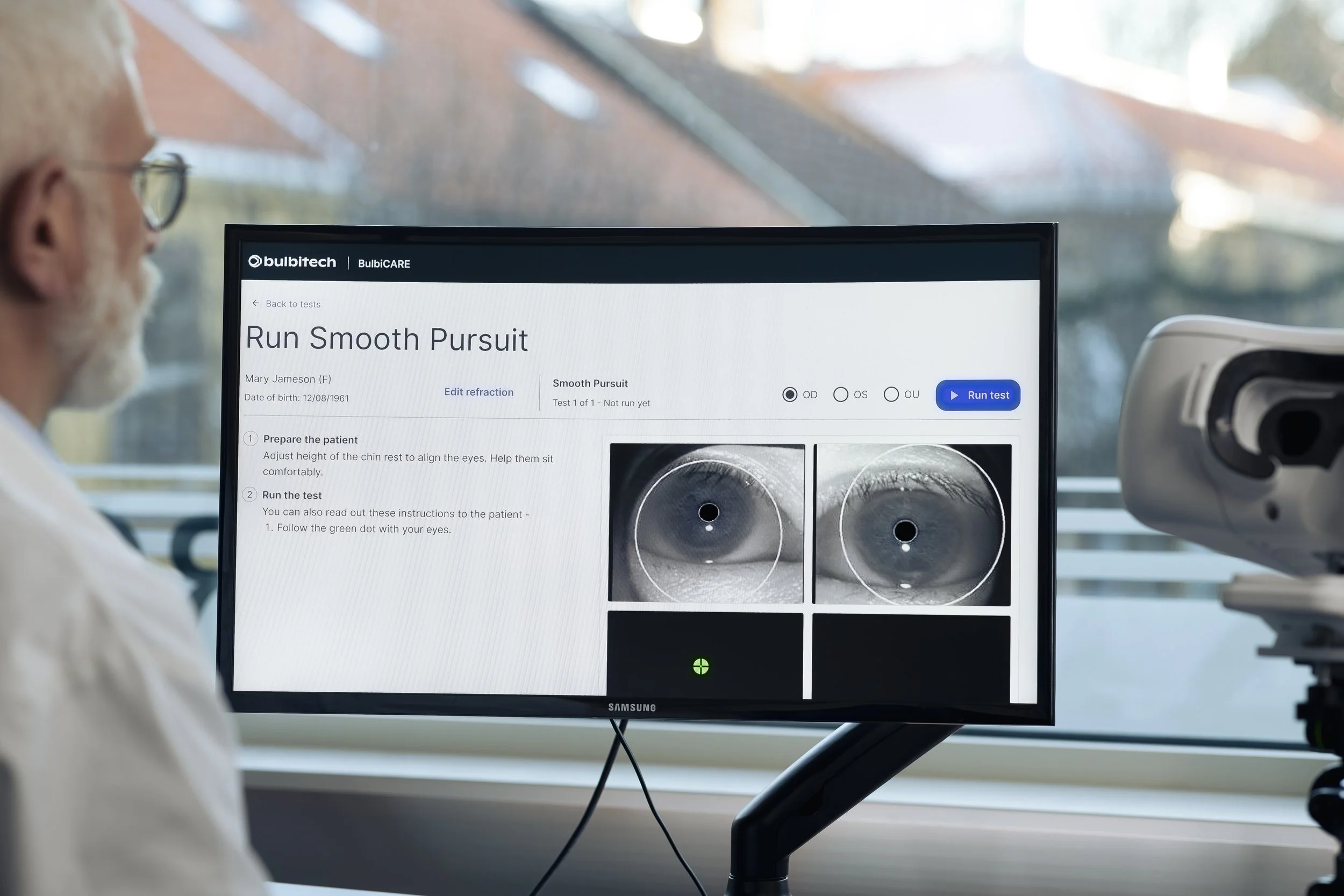
![A person in a white lab coat with glasses is looking at a computer monitor displaying an eye test for a procedure called Run Smooth Pursuit. The screen shows instructions and two close-up black-and-white images of eyes with targets to follow for testing.]()
3. Run tests
-
![Medical professional reviewing a computer screen displaying results for a 'Smooth Pursuit' eye test, with a medical device and a window in the background.]()
4. View results
-
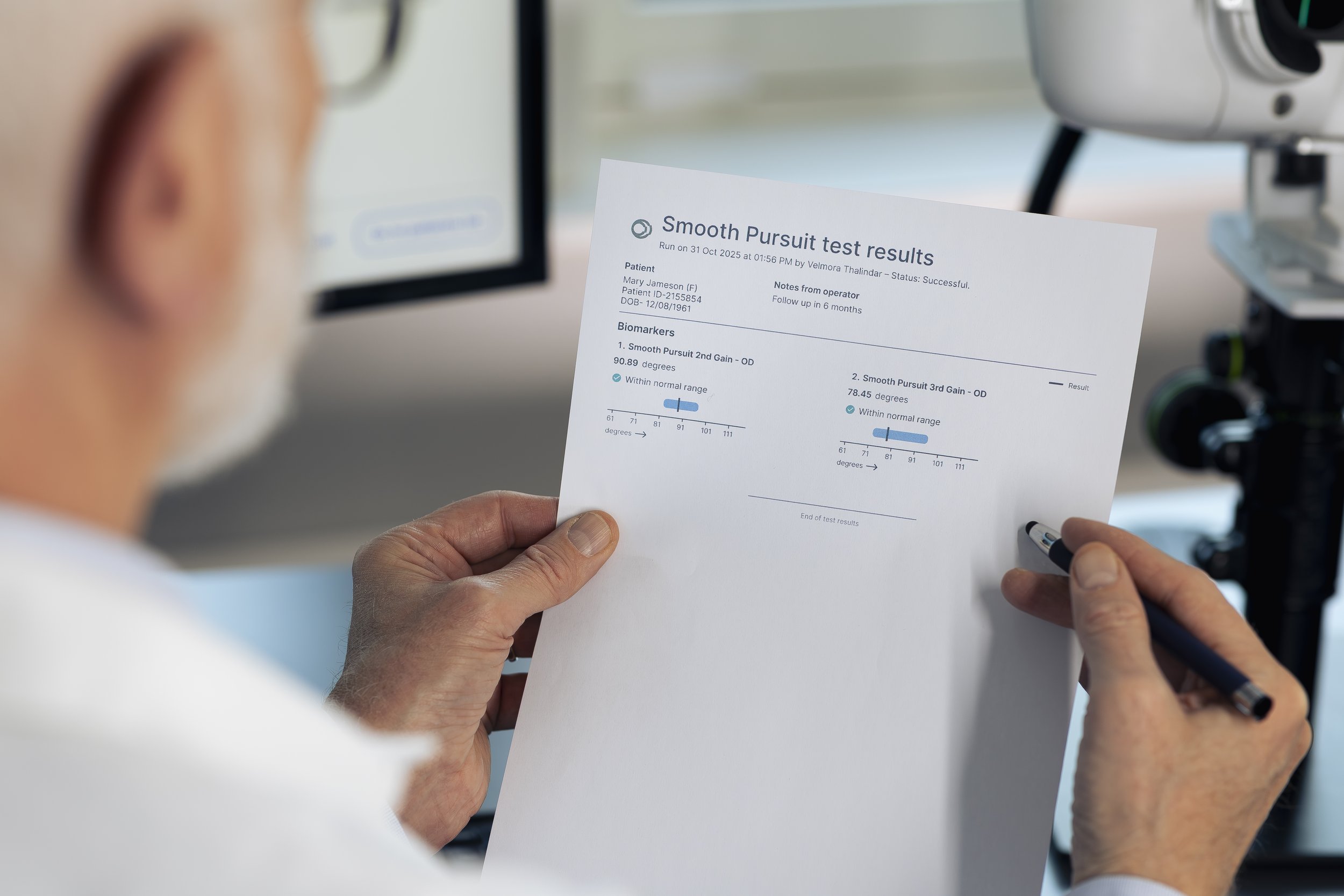
![A person holding a medical test results paper titled 'Smooth Pursuit test results' with graphs and medical data, in a clinical setting equipped with a microscope and computer screens.]()
5. Export results in PDF